
Delegation Dread
Why the visionaries who reimagine higher education are often the ones most reluctant to share the wheel.

You didn’t set out to build just another program.
You saw what higher education had become - bloated, bureaucratic, disconnected from the people it was supposed to serve - and you decided to do something about it. You designed the curriculum yourself. You recruited the first class personally. You knew every student’s name, every instructor’s quirk, every friction point in the student experience. You were, in the truest sense, the program.
And it worked.
The team you created mastered technology and created a curriculum free of many of the restraints that hindered growth and change; now the program is attracting a growing number of excited students. You have met the challenges of an accrediting body that quietly rooted for you but held you to outdated standards. The organization chart is no longer a single dot. What used to be accomplished over a cup of coffee now requires committee approval and endorsement by the university administration. Your organization has now reached a crucial threshold. You, as the founding dean and leader, must now trust others with making decisions that you used to make and then move on. You have reached the stage of growth that many leaders experience – delegation dread. The quiet crisis that visits every founder-educator at the exact moment their success demands that they begin to let go.
In traditional higher education, this tension is baked into the institution. Shared governance, faculty senates, and administrative layers - these are the established containers for distributed decision-making, however imperfect. But you didn’t build a traditional institution. You built something lean, intentional, and deeply personal. And now the very intimacy that made it exceptional is making it nearly impossible to scale.
This is not a failure of vision. It’s the inevitable collision between the founder you had to be and the leader you need to become.
Over my years in higher education administration, I have frequently witnessed leaders who could envision a successful future for their organization but could not figure out how to get it there. It reminds me of two quotations that are attributed to one of the most visionary leaders of our time, Thomas Alva Edison. Edison was a prolific inventor, with 1,093 U.S. Patents to his credit. What is most notable is that he created his famous Menlo Park laboratory in New Jersey (1876–1890), which created the phonograph (1877), Incandescent light bulb (1879), first commercial electrical power station (1882), and then followed with an entire electrical distribution system that led to The Rural Electrification Administration (REA) being created in 1935.
The two quotations that are attributed to him and that reflect his philosophy are
A vision without execution is hallucination.
and
Genius is one percent inspiration and ninety-nine percent perspiration.
These two philosophical statements should be on the mind of every leader who is attempting to move an organization forward today. It takes more than a passing thought to realize a vision, and then it takes work, lots of work, by a dedicated team that shares that vision. I lost count of people who came up to me at professional meetings or later in my life with a remark that you created a very innovative school of pharmacy without acknowledging the work and dedication that went into making that vision a reality. They would generally make some deliberately vague comment about how you made it look easy. The inference was that it was probably just luck.
Admittedly, timing is important. When you are a startup, you must seize opportunities that other, more well-funded programs cautiously ignore. They would prefer to let someone else take the risks, but then they are quick to adopt those successes and pour resources into scaling. The advantage that innovative leaders and business startups have is that they can make decisions more quickly and then round up the resources needed to pilot the idea. One of the most important resources that a leader can possess is the ability to attract the right individuals who share both the vision and the willingness to take the risk.

In the Anatomy of a Startup, I outlined the creation of a new innovative school of pharmacy and observed that
I have found that you will receive a significant amount of interest from three types of faculty and administrators:
• Those interested in a challenge
• Those who are unhappy
• Those who are respected as teachers and administrators and who want a chance to demonstrate what they can accomplish.
Your goal is to obtain as many individuals from category three as you can find. Those interested in a challenge will typically become bored or disruptive, neither of which is a desirable arrangement. Those who are unhappy will typically be unhappy in a new program for many of the same reasons they were unhappy where they were. The trick is locating and attracting individuals who are passionate about teaching and are capable of dealing with change.
The same is true for any new startup. Equally important is that once you have found the right team, you must allow them to succeed. That requires more than leadership; it requires a willingness on the part of the leader to delegate to the team as they demonstrate capability.
Extensive research has focused on startups and the path they follow either to success or oblivion.
The Five-Year Wall: When Founders Become the Ceiling
Delegation is often misunderstood as a luxury - something leaders earn the right to do once their organization reaches a certain size. In reality, it is a foundational discipline, especially for startups. Early-stage leaders are typically builders, problem-solvers, and decision-makers by instinct, which makes letting go of control both difficult and counterintuitive. Yet the very behaviors that fuel a startup’s launch can become constraints on its growth. Effective delegation is not about offloading tasks; it is about transferring ownership, building capability in others, and creating the conditions for scale. For startup leaders, the ability to delegate is less a management technique and more a turning point - one that separates ventures that stall from those that evolve into sustainable organizations.
There is a persistent and well-documented pattern in startup development that deserves far more attention than it typically receives: the founder who built a company from nothing often becomes the single greatest obstacle to its continued growth - usually around the five-year mark.
According to U.S. Bureau of Labor Statistics data, roughly 48.4% of businesses fail within five years, making the five-year mark a recognized inflection point in startup survival. But the more interesting story isn’t about businesses that simply die - it’s about the ones that stall, plateau, or quietly decay while still technically alive, victims not of market failure but of leadership failure at the top. The most rigorous academic work on this subject comes from Harvard Business School professor Noam Wasserman, whose landmark 2008 Harvard Business Review article and subsequent book The Founder’s Dilemmas (Princeton University Press, 2012) drew on a decade of data from thousands of startups.
In Wasserman’s study of 6,000 startups, 65% of those that shuttered did so because of people problems, compared to 35% with product, functional, or market problems. This has led many to conclude that most, if not all, businesses reach a five-year ceiling where the entrepreneurial instincts that gave birth to the product or service are no longer sufficient to grow the enterprise.
For many founders, their startups are more than just businesses - they are deeply personal projects, often described as their baby. This emotional attachment fuels a sense of ownership that makes it difficult to entrust their vision to others. Founders tend to believe they are uniquely qualified to lead their companies, and in the early stages of development, this may have been true, but Wasserman’s research highlights that entrepreneurs consistently overestimate their chances of success compared to similar ventures. This overconfidence can blind founders to their own limitations, one of which is the inability to delegate effectively.
Psychology: Why Founders Can’t Let Go
The reluctance to delegate is not simply stubbornness. It is deeply wired into the founder’s identity and psychology.
Many founders are driven by a fear that if they hand off responsibilities, things will fall apart. This fear manifests in micromanagement or an inability to delegate, which suffocates the company’s ability to grow. Employees feel micromanaged, lose autonomy, and the company becomes reliant on the founder for every major decision, limiting the development of a capable leadership team. Psychological research on delegation avoidance in leadership reveals that the hesitation to delegate isn’t usually about quality; it’s rooted in a lack of trust. Founders often wrap their reluctance to delegate in narratives of perfection, but this quality protection hoax is more damaging than productive. Perceived perfectionism often masks a fear of losing control rather than an actual commitment to high standards.
The Inflection Point: When the Bottleneck Has a Name
In the early days, the founder and a small team could sit around a table and hash out decisions in real time - no complex layers of communication, no conflicting priorities. As the company grows, the inbox overflows, email messages pile up, and key decisions stall waiting for the founder’s input. This is the first major growth ceiling most startups hit: the point where founder involvement in every decision becomes the bottleneck.
Research from CREO Consulting maps this trajectory in terms of headcount rather than years, but the timing often aligns: the first inflection point occurs once headcount reaches approximately 50 people - the point at which the founder has typically hired everyone and has been responsible for most critical decisions. A second inflection point occurs around 125–150 employees, when founders often find there are employees they did not hire and do not interact with regularly. This is when defined business functions and formal organizational structures must emerge. It’s about identity, not incompetence. Many founders are extraordinarily capable people - but they are capable of founding, not necessarily of managing on a scale. These are genuinely different skills. The tragedy isn’t that founders are bad leaders; it’s that they are often excellent leaders for one phase of a company and not the next.
Anatomy of a Pharmacy School Startup
This research is not restricted to profit ventures; it also applies to higher education innovation and startups. The picture below is of the Bernard J. Dunn School of Pharmacy Leadership team. From a school of just three full-time individuals in the first year (Dean, Assistant Dean, and Administrative Assistant), we grew into a team of nine hardworking individuals who could meet in my living room. Communication was quick and reliable, and everyone assumed both responsibility and workload that most individuals would have avoided.

They shepherded the school of pharmacy through the first four critical years of the startup, culminating in the receipt of full accreditation. It was personally satisfying when our inaugural graduating class matched the first-time pharmacy licensing passage rates of other, more established schools. Ironically, it occurred at the five-year mark that most researchers predict represents a challenge for new startups. We were acutely aware that to continue growing, we would need a more formal decision-making process that involved delegation. The initial leadership team was not just employees - they were cultural co-founders. They set the tone, imprinted behaviors and values, and drew others to the school of pharmacy.
What Healthy Delegation Actually Looks Like
Effective delegation is not about offloading work - it’s about transferring ownership and accountability. Most founders don’t struggle to delegate tasks; they struggle to delegate decisions. Handing off a task is easy. But handing off a decision - like how to approach the creation of a totally online traditional and non-traditional curriculum and then, in a few years, a totally new curricular focus (e.g., Pharmacogenomics) as part of a joint venture with George Washington University, feels much riskier.
All of this happened over the next five years, when many leadership teams would relax and savor their accomplishment. We revamped our strategy to reflect the challenges of a growing and evolving organizational framework. We quickly realized that the inflection point isn’t strictly calendar-driven - it’s triggered by organizational complexity, typically arriving around 15–50 employees for many startups, which in a normally growing business lands right around the five-year window.
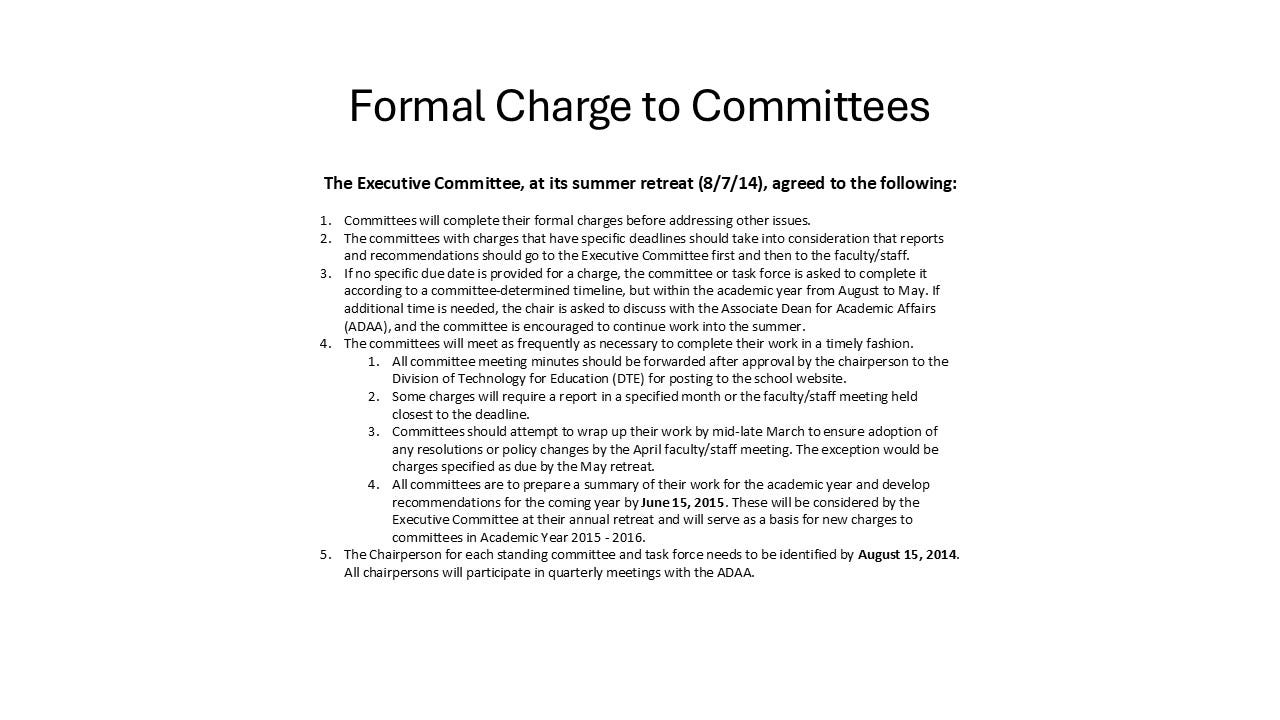
We moved from a relatively static strategic plan that was discussed once or twice a year to a dynamic strategic plan that was featured at every Executive Committee Meeting and served as the basis for the twice annual State of the School Report. We also added the formation of Task Forces to the original academic committees where a cross-committee focus was needed.
The image below is an abstraction from a Memo distributed to the faculty and staff (8/8/2014).
Along the way, I formed personal impressions of how and when effective delegation occurs. In the remaining space, I would like to explore some of those impressions.
Delegation Dread
Relinquishing control - Some leaders intellectually want to delegate but feel a visceral discomfort with uncertainty. This is particularly acute with a newly formed leadership team. Delegation means accepting outcomes you can’t fully predict or control. For anxiety-prone or high-stakes-oriented leaders, this ambiguity is genuinely distressing. The trade-off is more important. When people recognize that the founder is sharing the responsibility for the outcome, they become even more diligent in assuring success. The cruel paradox of delegation dread is that hoarding responsibility - whether from inadequacy fears or authority protection - actually produces the outcome the leader fears most. Teams become dependent and underdeveloped; the leader becomes a bottleneck; their reputation suffers, and their authority erodes organically. Delegation, done well, is what builds a leader’s stature, not diminishes it.
The leaders who delegate most confidently tend to have a secure sense that their value lies in judgment, vision, and development of others - not in being the one who executes every task. I used to remark to my leadership mentees that if I received five years of dedication and personal growth before they moved on, we would both be winners.
Resisting the Urge to Make the Startup Your Identity - Many leaders - especially founders, technical experts promoted into management, or lifelong high achievers - tie their sense of self to getting things done personally. Being seen as someone who works hard and delivers becomes their defining trait. As a result, delegating feels less like a practical handoff and more like giving away part of who they are. Their self-worth is wrapped up in execution.
Hard work and high output are admirable in a startup environment, but they must never become a substitute for effectiveness. Delegation is more than a time-saving tool - at its best, it is an act of development. When you delegate, you are not offloading work; you are transferring growth. A leader who holds onto every challenging task, believing it is their obligation to handle it personally, inadvertently denies their team the experiences that build real capability and confidence.
Match Tasks to People - When assigning work, think beyond who is most qualified. Consider who will grow the most from the experience. Align tasks with each person’s strengths, skills, and development goals. Delegation is both a productivity strategy and a coaching opportunity.
This requires two things from a leader: an honest understanding of each team member’s current capabilities and the willingness to stretch people beyond their comfort zone. When someone falls short, that is not the end - it is information. Reassess, adjust, and try again.
I once asked a faculty member with a strong oncology background to explore the emerging intersection of oncology and pharmacogenomics. The use of biomarkers to guide treatment choice was still a developing concept, and I needed someone to lead that area of our curriculum. When I raised it with him, he was candid - he knew very little about the subject. I appreciated his honesty, and I gave a simple task: find a conference where the topic would be featured.
A few weeks later, he returned with a lead - a conference in San Francisco that was relevant but expensive. He assumed I would say no. Instead, I told him to register and report back on what he found.
When he returned from the conference, he came straight to my office. His first words were, I had no idea. That experience changed him. He shed his hesitation about a fast-moving field and became one of the most vocal advocates among the faculty for integrating pharmacogenomics into the curriculum.
Be Clear on Outcomes, Not Methods - When you delegate, define what success looks like - the deadline, the quality standard, the expected result. What you should not define is exactly how the work gets done. Giving people ownership over their approach fosters creativity and personal investment. Prescribing every step does the opposite. In the early stages of the pharmacy school, we would agree on strategic initiatives at our annual retreat. It would be codified in the strategic plan and then would not be visited until the next retreat a year later, when the results would typically be a mixed bag. Some goals had been carried out, but they were typically limited to aggressive committee chairpersons who poured time and effort into their charge. There was also limited crosspollination with initiatives that needed coordination across several committees. In 2011, we shifted from retreat-driven plans to formal committee charges. They would begin with open discussions at the retreat, typically in May, but would be codified into a formal charge to all committees, both standing and task forces. The formal charges became part of the strategic plan, and more importantly, they would be shared with the faculty and staff at the first regular faculty/staff meeting in the fall.
Set Checkpoints, Not Micromanagement - Agree on check-ins at the outset so that progress stays visible without requiring constant oversight. This helps both sides: the team member feels supported, and the leader stays informed without hovering.
In practice, we addressed this through regularly scheduled Executive Committee meetings. Each member - and occasionally outside guests - was expected to formally report on progress toward the components of the strategic plan they owned. This eliminated a common leadership pitfall: assigning a critical task and then quietly assuming it will get done. You have to build in the expectation that the person responsible will either complete the task within a reasonable timeframe or proactively account for any delay.
Resist the Rescue Reflex - When someone struggles with a delegated task, the natural instinct is to take it back. Resist that impulse. Step into coach, not to reclaim. If people learn that struggling leads to being relieved of responsibility, they will never develop the resilience they need. Helping someone work through difficulty teaches them far more than removing the difficulty ever could.
Accept Good Enough as Sufficient - An 80% solution delivered by someone who truly owns it is often more valuable than a perfect solution reclaimed and finished by the leader. Perfectionism is the most common reason delegation fails.
The Real Shift: From Doing to Leading
Delegation anxiety is something nearly every leader struggles with. But the essential mental shift is this: moving from I am responsible for doing this to I am responsible for this getting done well. That distinction - simple as it sounds - is what separates a manager from a true leader.