
Integrity
The authentic leader

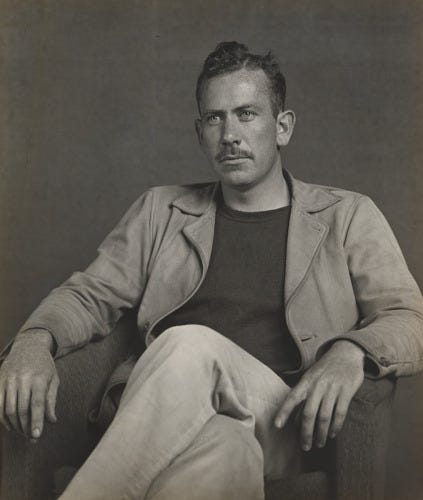
                                                          John Steinbeck
                                                   National Portrait Gallery
                                                    Smithsonian Institution
The things we admire in men, kindness, generosity, openness, honesty, understanding, and feelings, are the concomitants of failure in our system.
And those traits we detest, sharpness and greed, acquisitiveness, meanness, egotism, and self-interest, are the traits of success.
And while men admire the qualities of the first, they love the product of the second.
					                                    John Steinbeck (Cannery Row, 1945)
This quotation by Steinbeck, like many of his works, takes an ironic view of humanity, but it resonates with individuals who are challenged with leading a complex organization in a rapidly changing world. While leaders may want to maintain their integrity, there are many forces at work challenging their personal code of conduct and questioning their authenticity.
It is probably an overly simplistic assumption that integrity begins with proper potty training, but it does begin with the role models that we have as children, both good and bad. When we are young, we take the view that people are what they say they are, and they behave in a fashion that is kind and protective. It is only as we advance through childhood to adolescence that we begin to form a different impression of people’s behavior. We see a lack of impulse control, self-serving behavior, and dishonesty.
The expectation is that adults don’t behave that way. We enter the workplace and find that, indeed, they do behave in ways that are almost childlike, as if their emotional development stopped with a bad potty experience.
The impression takes on added importance when, as Steinbeck sagely noted, we reward (or tolerate) bad behavior. How do leaders function in a world that seems determined to diminish their personal integrity? There are no simple answers, but there are a few areas where leaders need to focus their attention, some of which are personal and some interpersonal.
· Personal accountability – Leaders who accept responsibility for their decisions and the actions of their team are viewed as having integrity. That means absolute, unwavering self-honesty and a willingness to admit mistakes. A leader with integrity never hides behind others or shifts the blame for a bad result to other individuals.
I am reminded of an anonymous six (6) line description of the phases of a project that correctly describes the experiences many of us have had when faced with incompetent leaders.
Phases of a Project
1. Enthusiasm
2. Disillusionment
3. Panic
4. Search for the guilty
5. Punishment of the innocent
6. Praise and honors for the non-participants.
· Authenticity – Sometimes confused with directness or bluntness, authenticity is the quality of a leader who is always honest. They don’t do fake nice. They look people in the eye and tell them like it is. They are considerate and polite, but they tell the truth – always. They operate according to their own moral compass and make decisions on what they believe is right and wrong. If it sounds judgmental, then that is a matter of interpretation and not a true reflection of the character of a leader with integrity.
I had two rules when the school of pharmacy was established. Rule number one was that no one, including the dean, was to put anything on their door other than their name. No titles, no certifications – nothing but their name. New faculty would question why they were not allowed to establish their credibility by posting their academic and professional credentials. My response was that their actions (e.g., research, teaching, and professional mentoring) were the things that they should be recognized for, not their titles.
Second, unless they are dealing with confidential matters, faculty office doors are to remain open at all times. This also established professional credibility by indicating to students, staff, and colleagues who walked by that you were available for conversation, to clarify a lecture, or simply to engage in meaningful dialogue.
Authenticity is often difficult to cultivate and easy to lose. Even small gestures can mean a lot to a new student trying to find their footing, a colleague who is facing a challenge, or a staff member who is uncertain of how they fit into an academic setting.
I have had many former students and colleagues who remarked years after we parted that the most meaningful lesson they learned about the faculty of the school of pharmacy was how approachable they were and how significant that was in their professional development.
· Diligence - Leaders who have integrity are awake while others sleep. They devote enormous energy and attention to details that others may consider insignificant. My father used to comment that if a leader doesn’t do their job correctly and early, others often pay the price. Leaders with integrity devote the time and attention to detail that is often exasperating to others but is necessary to them.
He related a story based on a personal experience that resonates with this trait. He was supervising the construction of an important research facility in downtown Atlanta. He summoned a crew chief into the contractor’s trailer and told him that he was to demolish a wall that had just been constructed by his crew. The crew chief was incredulous and in a loud voice stated, There is no way I am going to demolish a twenty-foot, rebar reinforced 18” wall! Before my father could respond, the contractor walked into the trailer, and the crew chief, thinking he could appeal to him on the grounds of lost time and resources, declared, This idiot wants me to tear down a wall we just constructed! The contractor turned to my dad for an explanation.
My dad responded calmly, I came in early today to check on the wall. The crew chief was asked to construct the wall according to the blueprints and my instructions. Upon checking the wall, I discovered that it was not plumb (e.g., straight up and down). Do you want it to become known that the concrete containment wall for a research nuclear reactor in downtown Atlanta is faulty? It didn’t take the contractor long to reach a decision. He turned to the crew chief and stated emphatically, I would suggest you round up your crew and get started demolishing that wall.
· Wisdom – Wise leaders protect their teams from unfair criticism; they provide the guidance and resources to make the desired outcome a reality, and they invest their personal time and prestige in any effort they undertake. While delegation does occur, it is with consideration for the delegate’s ability to carry out the task. That involves a combination of accurately assessing the individual’s ability and sometimes stretching that ability so that the individual grows during the process.
· Conscientiousness – Leaders have bosses. They have an obligation to contribute to their bosses’ success through careful consideration of what is being asked of them and providing the support needed for a successful outcome. They do not, however, follow blindly. When they have questions, they ask; when they have doubts that arise, and if they are not capable of providing the support needed for the project, they may need to step aside (or else sacrifice their integrity). As noted in an earlier post, each day that the leader faces begins with the assumption that they may be asked to make compromises. Integrity is never taken from a leader. It is given away in each small, almost inconsequential compromise that they are asked to make, which, upon reflection, is not in the common good. Compromise can, however, achieve the common good if it is done in a spirit of cooperation and to recognize different viewpoints.
· Vision –Effective leaders are chosen and followed because they have vision. It often exceeds the ability of their team or their organization to grasp the fullness of their vision, but a leader with vision is able to paint a clear image of expectations, possible challenges, and the value of the ultimate outcome.
· Consistency – Effective leaders are the same regardless of with whom they are interacting. They behave with courtesy, respect, and honesty toward family members, teams, and members of the organization, regardless of status. They respect the contributions of staff members because they provide valuable insights into organizational weaknesses and provide creative solutions to potential problems. They do not alter their behavior when they are dealing with different individuals.
· Loving few, respecting many – Leaders treat others with respect, even those with whom they disagree. They are careful about making friendships and even more cautious about who they love. They need to trust someone, and the few friends that they make are privileged to know the most intimate details of their fears, aspirations, and plans. I can count on two hands the friends I have made over my lifetime, and each one was a treasure. The leaders I have known and respected for their integrity don’t have time for broken hearts and toxic relationships. They are selective, authentic, and trustworthy. They are faithful in romance, and when they are in a relationship, they don’t cheat. Period.
· Trustworthy – Leaders who exhibit integrity are passionate about their work and their teams. They are known and respected for being trustworthy. Being an effective leader does not require being a friend to those you lead, but it does require respect, caring, consideration, and compassion. Leaders earn respect. It is not bestowed on them because they have a title; it is earned through the eyes of their colleagues who value their insights and trust their judgment. Mark Twain once remarked, Always do right. This will gratify some people and astonish the rest.
Years ago, I came across a short, anonymous list of attributes associated with integrity. They were a valuable reminder of the importance of the trait in leaders. I kept a copy in my diary and transferred it each year. In quiet moments or when I was feeling under attack for my actions, I would take it out and review the list. It helped me to muscle through. I share them with you because leaders need to be reminded occasionally why people trust, follow, and believe in them.
On Personal Conduct
1. Never compromise your integrity for anyone or anything.
2. Don’t try to be all things to all people. Learn to say no politely and pleasantly, but immediately and firmly.
3. Never wait for something to happen; make it happen! Do it now
4. Do not be overwhelmed by the tasks before you. Don’t try to do everything, just do something.
5. To accomplish your objective, first begin. Second, concentrate exclusively on the project at hand. Third, don't stop.
6. Let circumstances dictate your priorities. Let priorities determine your actions.
7. Focus your efforts on the crux of the problem. Don’t expend energy on peripheral issues that are not crucial to producing results.
8. For maximum effectiveness, do only what you do best and let others do the rest.
9. Concentrate on long-term, permanent solutions rather than stopgap measures.
10. Don’t waste time telling people what you're doing or what you're going to do. Results have a way of informing the world.
11. Don’t make promises you can't keep; once made, keep them.
12. Don’t be tempted to take the easy way out. Have the self-discipline to do the right thing rather than the instinctive thing.
13. Don’t become lax; play every point as though it were match point.
14. Avoid premature celebrations. You’re not through until you’ve dotted all the i’s and crossed all the t’s – and the check has cleared the bank.
I will leave you with a quotation from someone far wiser than myself, Warren Buffet, CEO of Berkshire-Hathaway
In looking for people to hire, you look for three qualities: integrity, intelligence, and energy.
And if they don’t have the first, the other two will kill you.[1]
[1] 1994 January 2, Omaha World-Herald, Section: Business, Billionaire Talks Strategy with Students Columbia University Group Hears From Famous Alumnus Berkshire Hathaway by Jim Rasmussen (Herald Staff Writer), Quote Page 17S, Omaha, Nebraska. (NewsBank Access World News)
Very good. Thanks.
Spot on advice from a leader who has has proven himself over decades of service to higher education.