
The Most Important Skill We Never Teach

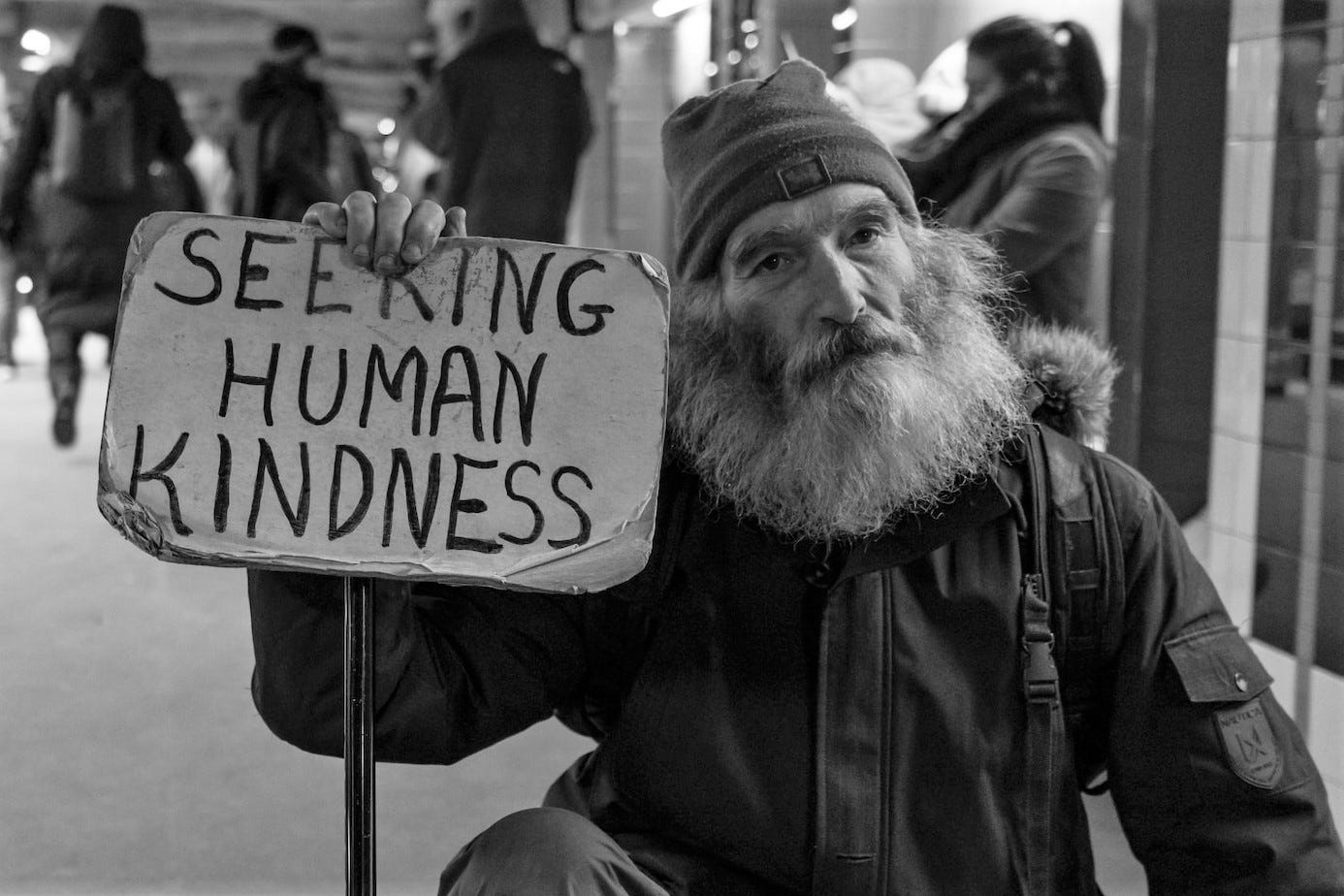
Do you have a large garbage bag?
That was the first thing a man said to me on the opening night of the Winchester Area Temporary Thermal Shelter (WATTS), where I was volunteering as a night aide.
WATTS exists because of a tragedy. During the winter of 2008–2009, a man experiencing homelessness froze to death on the streets of Winchester, Virginia. In the aftermath, local faith leaders realized something uncomfortable: dozens of churches sat empty every night - heated, with kitchens and restrooms - while people slept outside in life-threatening cold. They built a rotating shelter program so that no one in the community would ever again die from exposure.
Our congregation agreed to host the pilot night. I signed up to help, alongside another volunteer and the shelter supervisor.
After dinner, about thirty guests - mostly men - settled onto cots across the fellowship hall. As I stood talking with the supervisor, one man motioned for me to come over. He was large, thick-bearded, and wearing a worn snowmobile suit that had clearly survived many winters.
Do you have a large garbage bag? he asked quietly.
I do.
Could you get it for me? I need help getting out of these coveralls.
I came back with a thirty-gallon bag. Together we peeled away the insulated suit - filthy, threadbare, unmistakably a garment that hadn’t been washed in a very long time. Once it was off, we stuffed it into the bag, and I carried it to the trash. When I returned, he was pulling on a second set of clothes from his backpack.
Anything else I can do? I asked.
He gave a weary smile. No. That was great.
We talked for a few minutes. I asked where he spent his days when the shelter wasn’t open.
I walk, he said.
All day?
He nodded. If I stop, I might get arrested for loitering. I’ve seen enough jails.
That sentence has stayed with me for years.
Walking back to the supervisor’s table, two thoughts hit me at once. First, I had only begun to understand how exhausting life can be on the margins of society. Second, I realized that on a night when the temperature outside would fall to nine degrees, this fellowship hall was the difference between life and death for the people sleeping in it.
No lecture could have taught me what those ten minutes taught me. No dataset could have either - some things you only learn by being in the room.
Why We Built Service Learning Into Year One
When we designed the first-year curriculum for our School of Pharmacy, we made service learning a required experience - not so students could log volunteer hours, but so they could learn to observe. The community, we decided, is the best laboratory in the world.
Service learning is a structured educational approach that combines meaningful community service with intentional reflection and faculty guidance, helping students apply academic concepts while building professional competence, civic responsibility, and lifelong learning skills.
But in the Adaptive University Model, service learning isn’t primarily about community service at all. It’s a deliberate strategy for teaching first-year students how to see. Students are embedded in volunteer organizations where they watch, closely and repeatedly, how people, teams, and organizations function in real-world settings. Instead of rushing to solve problems, they practice noticing: patterns, workflows, communication, leadership behavior, decision-making, unmet needs.
At each site, volunteers work with a Service-Learning Coordinator to guide student teams through structured observation exercises, reflective discussions, and evidence-based analysis. Students learn to separate fact from assumption and to ask sharper questions. These are the same muscles that later underpin critical thinking, sound judgment, and the ability to use any tool - including AI - well rather than carelessly.
By turning volunteer organizations into authentic learning laboratories, the model develops students who don’t just know things: they’ve learned to see before they solve. That’s a competency that underlies successful professional practice in every field.
What the Journals Revealed
Our student teams worked alongside organizations serving people with mental illness, answered crisis hotline calls under supervision, assisted in domestic violence shelters, tutored adults in literacy programs, and volunteered in soup kitchens serving the homeless. Afterward, each student reflected on their experiences in a journal shared with their site mentor and the Service-Learning Coordinator.
Our Service-Learning Coordinator recently told me she’d been rereading those journals, and that the reflections still move her, even after all these years. What she described echoed the lesson I learned that frosty winter night: observation is not a passive act. It is the beginning of understanding.
It builds empathy before judgment, curiosity before certainty, insight before action. It teaches students to notice the lives, struggles, and strengths that stay invisible to anyone who never leaves the classroom. And it reminds future professionals of something easy to forget: every decision they make ultimately lands on another human being.
The Skill AI Can’t Replace
We spend enormous energy teaching students what to think and remarkably little teaching them how to observe. But without careful observation, there is no meaningful critical thinking. The best physicians, pharmacists, nurses, engineers, teachers, and business leaders share one trait: they notice what others miss.
That trait matters more, not less, in an age of artificial intelligence. AI can analyze data, summarize a transcript, even flag a pattern buried in a spreadsheet. What it cannot do is sit across from a man in a snowmobile suit and understand, in a single quiet sentence, what it costs to survive outside all day rather than risk arrest for standing still. That kind of understanding still has to be learned the old way - in person, in the room, paying attention.
If higher education is serious about preparing graduates for a future built alongside AI, observation needs to become a deliberate learning outcome, not an accidental by-product.
Sometimes that journey begins with nothing more than a quiet request for a garbage bag.
In my next post: how service learning evolved into one of the foundational pillars of the Adaptive University - and why volunteer organizations and businesses may be the best classrooms ever created.
As a former student of the service learning model, I absolutely concur that what we learned to observe was far more valuable than what we saw. I still use those written reflections to learn from and it has helped me to impact patient lives in more ways than I could have ever believed. Your influence is continuing to help change the world.
Good words fellow Navy Hospital Corpsman. Bravo Zulu